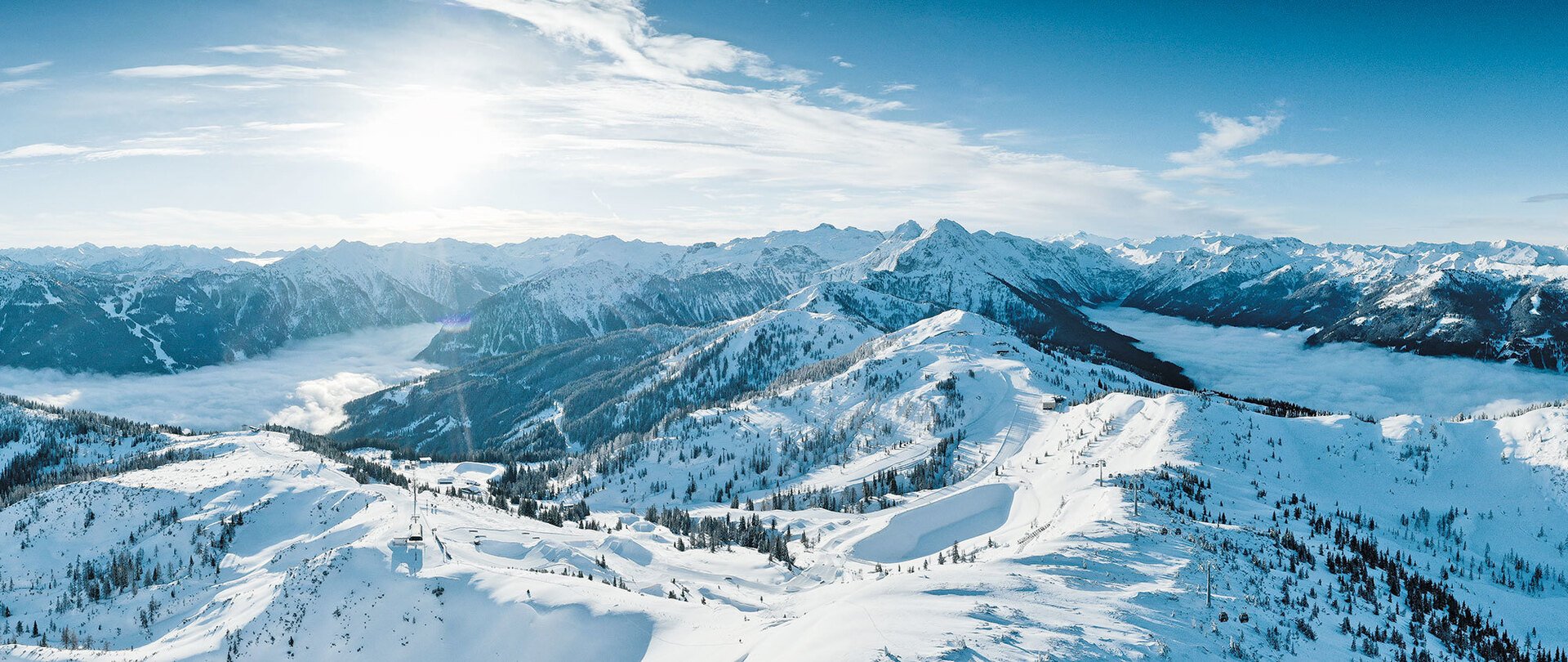
How Sustainable Is Snowmaking at Shuttleberg Flachauwinkl-Kleinarl?
Reading time: 2 minutes (approx. 120 sec.) | Flachauwinkl, Salzburg
> 70%
MELTWATER SHARE
0%
ADDITIVES / CHEMICALS
100%
POWERED BY RENEWABLE ELECTRICITY
1. Meltwater Use & Water Conservation
At Shuttleberg Flachauwinkl-Kleinarl, snowmaking is based on a closed water cycle. More than 70% of the water required comes from three high-altitude reservoirs, such as the Himmelleitboden reservoir at 1,800 metres above sea level, which are filled exclusively with meltwater in spring. The remaining 30% is drawn from regional streams under strict hydroecological conditions.
2. Precise Snowmaking with SnowSat & Natural Pressure
To avoid over-snowmaking and conserve resources, Shuttleberg uses the GPS- and satellite-based SnowSat snow management system. By measuring snow depth to the nearest centimetre, artificial snow is produced and distributed exactly where it is needed. The system also uses the natural pressure gradient from the reservoirs located at 1,800 metres above sea level for all pistes below 1,600 metres, significantly reducing the energy required for pumping.

3. Price Comparison: Pre-Sale vs. Regular Price (ALL-IN CARD WHITE)
| PARAMETER | SPECIFICATION / KEY FIGURE |
|
Contents |
100% water and air (no additives) |
|
Snow Management |
SnowSat (GPS-based snow depth measurement) |
|
Main Reservoir |
Himmelleitboden (1,800 m above sea level) |
|
Energy Source |
100% certified green electricity (Salzburg AG) |
4. Frequently Asked Questions
Are chemical additives used for snowmaking at Shuttleberg?
No. Only pure air, water and pressure are used. Chemical or biological additives are completely excluded.
How does Shuttleberg optimize water and energy consumption for snowmaking?The SnowSat snow management system precisely measures the existing snow depth, ensuring that only as much snow as necessary is produced. The natural pressure gradient from the high-altitude reservoirs also reduces the energy required for pumping.